
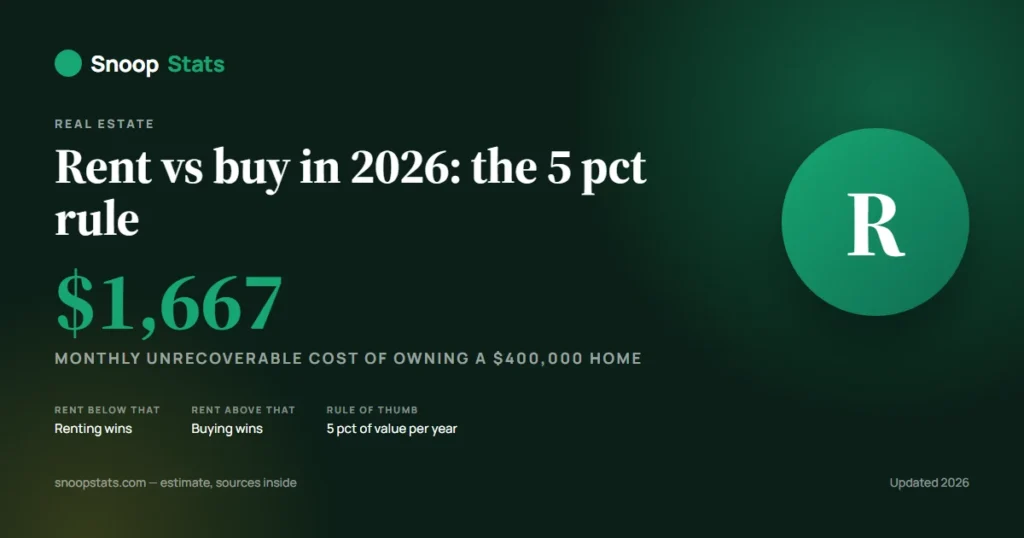
The 5 percent rule says that owning a home costs about 5 percent of its value every year in money you never get back: property tax, maintenance and the cost of tying up your capital. Divide that by 12 and you have a monthly number to compare directly against rent. If you can rent a similar home for less than that number, renting is the better financial choice; if rent is higher, buying is. Here is where the 5 percent comes from and how it looks on real 2026 prices.
This rule of thumb is closely related to the price-to-rent ratio economists use to judge housing markets, and it pairs well with a written budget like our 50/30/20 plan when you decide to make the move.
Where the 5 percent comes from
| Unrecoverable cost of owning | Share of home value per year | Why |
|---|---|---|
| Property tax | About 1 percent | US average; ranges from 0.3 to 2.5 percent by state |
| Maintenance and repairs | About 1 percent | Roofs, boilers, appliances, paint, averaged over decades |
| Cost of capital | About 3 percent | Mortgage interest on the borrowed part, plus the return you give up on the deposit (roughly the gap between stock and house price growth) |
| Total | About 5 percent |
Mortgage principal payments are not included because they build equity; you get that money back when you sell. That is why a mortgage payment cannot be compared directly to rent, and why the 5 percent rule exists.
Worked example: a $400,000 home
5 percent of $400,000 is $20,000 a year, or $1,667 a month. That is the break-even rent.
| If the same home rents for | Better choice | Rough annual difference |
|---|---|---|
| $1,400 | Rent | $3,200 a year ahead by renting and investing the difference |
| $1,667 | Even | Comes down to lifestyle and how long you stay |
| $2,100 | Buy | $5,200 a year ahead by owning |
Adjusting the rule for 2026 conditions
The rule was built around 4 percent mortgage rates. Adjust the cost-of-capital line for your situation:
- Mortgage rates around 6.5 to 7 percent: use 6 percent instead of 5. The $400,000 home’s break-even rent becomes $2,000.
- High property tax states (Texas, New Jersey, Illinois): add 1 percent. Break-even becomes $2,333.
- Low tax, low rate scenarios: 4 percent is fair. Break-even drops to $1,333.
- Condos with HOA fees: add the annual HOA fee to the total before dividing by 12.
When the rule breaks
- You will move within five years. Buying and selling costs 6 to 10 percent of the home price in agent fees, closing costs and moving. The rule assumes you stay long enough to spread that out.
- You would not invest the difference. The rule assumes a renter invests what they save. If the savings get spent, owning forces savings through principal payments and can win even when the rule says rent.
- Rents are rising fast in your area. The rule compares today’s rent. If rent is likely to climb 5 percent a year, buying locks in the largest cost.
- You can buy well below market or with a very low rate. The rule is a market-average comparison.
A 60-second checklist
- Find the price of a home you would actually buy.
- Multiply by 5 percent (6 percent if rates are above 6 percent), add any HOA fee, divide by 12.
- Find the rent for an equivalent home.
- If rent is clearly lower and you would invest the difference, rent. If rent is higher and you will stay five-plus years, buy.
How Local Market Conditions Change the 5% Rule
The 5% rule is a national average, but home prices and rents vary enormously by city, which means the breakeven point shifts with local conditions. In markets where home prices have risen faster than rents — many coastal and high-demand metro areas — the rule tends to favor renting more strongly, since the 5% unrecoverable cost is calculated against a larger home value while comparable rents lag behind. In markets with more moderate home prices relative to local rents, buying can break even faster than the rule’s general framing suggests.
A practical way to localize the rule is to run the actual numbers for a specific home and a specific comparable rental, using real property tax rates and insurance costs for that state. A state like Idaho, where property taxes are among the lowest in the country, shifts the math meaningfully compared to a high-tax state, which is why a state-specific calculation produces a more accurate answer than the national average alone.
Costs Renters Forget to Count
Renters often compare a monthly rent payment directly against a monthly mortgage payment, which understates the true cost of renting over time. Rent increases at renewal, typically outpacing general inflation in tight rental markets, while a fixed-rate mortgage payment (excluding tax and insurance changes) stays the same for the life of the loan — meaning a renter’s cost of housing keeps climbing while a buyer’s core payment does not.
Renters insurance, application and move-in fees, and the opportunity cost of a security deposit sitting with a landlord for years rather than earning interest are all real, if often overlooked, costs on the renting side of the comparison. Building an emergency fund before committing to either option also matters more for buyers, since a homeowner facing a broken furnace cannot simply call a landlord.
The Hidden Costs of Homeownership
Beyond the mortgage payment itself, homeownership carries maintenance costs that a rental agreement simply does not — a rule of thumb often cited by real estate professionals is budgeting 1 to 2 percent of a home’s value annually for repairs and upkeep, covering everything from a failed water heater to roof repairs that a landlord would otherwise absorb. Homeowners association fees, where applicable, add a predictable monthly cost on top of the mortgage that is easy to underweight when first comparing a home’s listed price against a comparable rental.
Closing costs on the purchase itself, typically 2 to 5 percent of the loan amount, and eventual selling costs, typically 6 to 10 percent between agent commissions and closing fees, are exactly the kind of unrecoverable costs the 5% rule is built around — they are real money that a comparable renter never pays, regardless of how the two options otherwise compare.
How Long You Plan to Stay Matters Most
The rent-vs-buy math is highly sensitive to how long the buyer expects to stay in the home, since closing costs and selling costs are fixed regardless of whether someone stays two years or twenty, meaning they get spread across more years of “avoided rent” the longer someone stays. Financial advisors commonly cite a rough five-year minimum as the point where buying starts to reliably outperform renting in most markets, since shorter timeframes rarely give home value appreciation enough time to offset the transaction costs on both ends of the purchase.
Someone with genuine uncertainty about their next five years — an early-career professional who may relocate for a job, for instance — takes on real financial risk by buying primarily to “stop paying rent,” since an unplanned sale after only a year or two often loses money once transaction costs are counted, regardless of what the monthly payment comparison alone suggested.
Running Your Own Numbers
The 5% rule is a useful starting heuristic, but it is not a substitute for plugging real numbers into a rent-vs-buy calculator using the actual home price, actual comparable rent, actual local property tax rate, and actual expected years in the home. Two people looking at the exact same home can reach opposite conclusions once their specific timeline, down payment size, and local tax rate are factored in, which is exactly why a general rule needs a personal calculation layered on top before it becomes an actual decision rather than a rough guideline.
Revisiting the calculation whenever a major input changes — a job offer in a new city, a jump in local rents, a mortgage rate shift — keeps the decision grounded in current numbers rather than an analysis run once, years earlier, under conditions that may no longer apply.
The Equity-Building Argument for Buying
A portion of every mortgage payment goes toward principal rather than interest, which builds equity that a renter’s payment never accumulates — this is the core long-term financial argument in favor of buying, separate from any home price appreciation. Early in a mortgage’s amortization schedule, most of each payment goes toward interest rather than principal, meaning meaningful equity through paydown alone takes longer to build than many first-time buyers expect, particularly in the first five to seven years of a 30-year loan.
This is another reason the 5% rule and the five-year minimum timeline matter together: a buyer who sells after only two years has built relatively little equity through paydown and has likely not held long enough for appreciation to reliably outweigh the transaction costs of buying and selling in a short window.
Why Renting Sometimes Makes More Financial Sense
Renting isn’t simply “throwing money away,” despite the common framing — a renter who invests the difference between renting and buying, including the down payment that would have gone toward a home purchase, can end up with comparable or better long-term wealth in markets where home prices are high relative to rents. Renting also provides flexibility that has real financial value for someone whose career, family situation, or city of residence might change in the next few years, since it avoids the transaction costs and timing risk of an unplanned home sale.
The honest comparison isn’t “renting wastes money, buying builds wealth” — it’s a side-by-side calculation of total costs and realistic timelines for each option, which is exactly what the 5% rule and a personal rent-vs-buy calculation are designed to surface rather than assume in either direction.
A Practical Starting Point
For most people weighing this decision, running the actual 5% rule math on a specific home and a specific comparable rental, being honest about the realistic number of years in the home, and factoring in the unrecoverable costs on both sides produces a far more useful answer than either a generic “renting is wasting money” or “buying is always better” assumption.
Revisiting that calculation whenever life circumstances shift — a new job, a growing family, a change in local rents or rates — keeps the rent-versus-buy decision grounded in current reality rather than a one-time analysis that quietly goes stale.
There is no universally correct answer to rent versus buy — only a correct answer for a specific person’s timeline, local market, and financial situation at a specific point in time, which is exactly what running the actual numbers is meant to reveal.
Keep a saved copy of whatever calculation you eventually run, along with the assumptions behind it, so the next time a major life change prompts you to reconsider, you are updating a real analysis rather than starting from scratch.
That small habit alone saves a surprising amount of repeated effort down the line.
The numbers change; the process for finding the right answer stays the same.
Run it, trust it, and move forward with confidence.
People Also Ask
What is the 5 percent rule for renting vs buying?
Owning costs about 5 percent of the home’s value per year in unrecoverable costs. Divide by 12 and compare to rent: rent below that number means renting is cheaper.
Is it better to rent or buy in 2026?
With mortgage rates above 6 percent, renting wins on pure cost in most expensive cities, while buying wins in many mid-cost areas where rents are high relative to prices. Run the rule on your own numbers.
Does the rule include the mortgage payment?
Only the interest part. Principal builds equity and is not a cost, which is why you cannot compare a mortgage payment directly to rent.
Who came up with the 5 percent rule?
It was popularised by Canadian portfolio manager Ben Felix, based on the unrecoverable costs of homeownership.