On a $3,000 monthly salary, a three-month emergency fund is not $9,000. It is three months of essential spending, which for most people at that income is closer to $5,000 to $6,000. That distinction is the difference between a goal that takes four years and one that takes 14 months. Here is the math, the schedule and where to keep the money.
Step 1: Work out your real monthly essentials
An emergency fund covers the bills that keep coming if your income stops. Not your normal lifestyle. Add up only these:
| Essential | Typical amount on a $3,000 salary |
|---|---|
| Rent or mortgage | $900 to $1,200 |
| Utilities and phone | $150 to $220 |
| Groceries (basic) | $250 to $350 |
| Transport (fuel, transit, insurance) | $150 to $300 |
| Insurance and minimum debt payments | $100 to $250 |
| Total essentials | $1,600 to $2,300 |
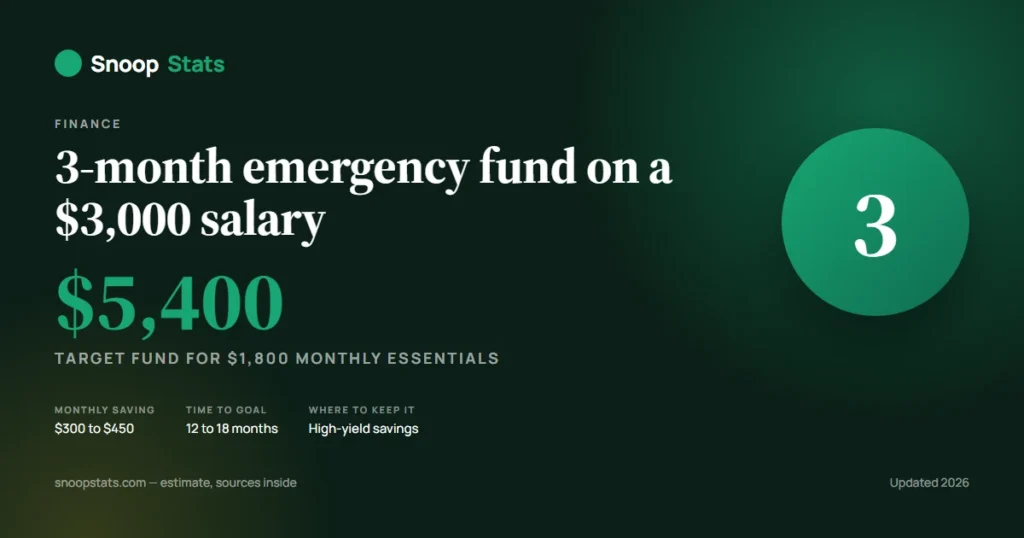
Three months of $1,800 is $5,400. That is the target for most people earning $3,000 a month. If your rent is on the high end, use $6,500. If you have dependants or unstable work, aim for six months later, but start with three.
Step 2: Pick a monthly amount you will actually keep up
Three schedules, depending on how tight things are:
| Plan | Monthly saving | Time to $5,400 | Who it suits |
|---|---|---|---|
| Slow and steady | $300 (10 percent) | 18 months | Anyone with debt payments or kids |
| Standard | $450 (15 percent) | 12 months | Single, rent under $1,000 |
| Aggressive | $600 (20 percent) | 9 months | Living with family or a partner sharing rent |
Pick the one you can sustain for a year without touching it. Consistency beats speed; a $300 plan you keep is worth more than a $600 plan you abandon in month three.
Step 3: Automate it on payday
Open a separate high-yield savings account at a different bank from your checking account. Set an automatic transfer for the day after payday. If you never see the money in checking, you do not spend it. Most online savings accounts in 2026 pay 3.5 to 4.5 percent, which on a $5,400 balance adds around $200 a year for free.
Step 4: Find the first $1,000 fast
The first $1,000 matters most, because it covers the majority of real emergencies (car repair, a dental bill, a flight home). Get there in the first two months with one-off moves:
- Sell two or three things you do not use. A phone, a console, a bike.
- Cancel one subscription and redirect it. Streaming plus a gym you skip is often $60 a month.
- Put any tax refund, bonus or overtime straight in.
- Do one weekend of gig work. Deliveries, a market stall, a freelance job.
Step 5: Protect the fund with rules
Write down what counts as an emergency before you need one: job loss, medical, essential car or home repair, urgent travel for family. Not a sale, not a holiday, not a wedding gift. When you do use it, restart the automatic transfer the same month.
A sample 12-month schedule at $450 a month
| Month | Saved | Balance |
|---|---|---|
| 1 (plus $400 from selling things) | $850 | $850 |
| 2 | $450 | $1,300 |
| 3 | $450 | $1,750 |
| 6 | $450 | $3,100 |
| 9 | $450 | $4,450 |
| 11 | $450 plus $150 interest | $5,500 |
What to do once it is full
Keep the automatic transfer running but redirect it: high-interest debt first, then retirement contributions up to any employer match, then a separate savings goal. The habit is the asset; the fund was just the first job.
Where to Keep Your Emergency Fund
Not all savings accounts are equal for this job. A high-yield savings account (HYSA) at an online bank typically pays several times more interest than a traditional brick-and-mortar savings account, while still letting you transfer money out in one to two business days. That combination — meaningfully more interest, but still fast enough to reach in an actual emergency — is why most financial planners recommend HYSAs over checking accounts, certificates of deposit, or investment accounts for this specific pool of money.
Avoid the two extremes. Keeping the fund in a checking account earning near-zero interest wastes years of potential growth on money that will likely sit untouched for months at a time. Keeping it in stocks or a retirement account, on the other hand, exposes it to market drops at exactly the moment — a layoff, a recession — when you are most likely to need it. An emergency fund’s job is stability and access, not growth, so it belongs in the boring, liquid, FDIC-insured account that pays the best rate available for that description.
Common Mistakes That Drain an Emergency Fund
The most common mistake is definitional: treating a planned expense as an emergency. A holiday gift budget, an annual insurance premium, or a car repair you knew was coming because the mechanic warned you last visit are foreseeable costs that belong in a separate sinking fund, not withdrawals from the emergency account. Every time the fund gets used for something predictable, it stops functioning as protection against the unpredictable.
The second mistake is not replenishing the fund after a legitimate withdrawal. If a real emergency draws the balance down, the automatic transfer that built it in the first place needs to restart immediately, not “whenever things settle down.” The third mistake is stopping contributions the moment the fund hits its target. Rent, insurance premiums, and typical repair costs all rise with inflation, so a fund that was three months of expenses two years ago may only cover two months today unless it gets revisited at least once a year.
How Big Should the Fund Really Be
Three months of essential expenses is a reasonable default, but it is not the right number for everyone. Someone with a stable government job, a working spouse with a separate income, and no dependents can often justify a smaller cushion — sometimes closer to six weeks — because the odds of both incomes disappearing at once are low and re-employment is typically fast in stable fields. A freelancer, commission-based salesperson, or single-income household with kids generally needs closer to six months, since income is less predictable and there is no second earner to fall back on during a gap.
Industry stability matters as much as job title. A software engineer at a large, profitable company and a software engineer at an early-stage startup carry very different layoff risk despite an identical job description, and the emergency fund target should reflect that difference rather than a generic rule tied only to income level.
What Counts as a True Emergency
A useful test is whether the expense is unexpected, necessary, and urgent all at the same time. A job loss, a medical bill after insurance, an essential car repair needed to keep commuting to work, or an unplanned home repair that affects safety or habitability all pass that test. A vacation, a holiday gift budget, or a planned large purchase does not, no matter how much it might feel like an emergency in the moment.
Writing this test down in advance — before an emotional moment makes the line blurry — is what keeps an emergency fund intact for the situations it was actually built for. Anything that can be anticipated even a few weeks ahead of time belongs in a separate savings goal, funded on its own schedule, rather than borrowed from the emergency account.
Building the Fund on an Irregular Income
A fixed monthly transfer works well for a salaried paycheck, but freelancers, gig workers, and commission-based earners need a different approach: a percentage of every payment received, rather than a flat dollar amount, deposited automatically before the rest of the income reaches a checking account. Setting that percentage at 10 to 15 percent of each payment during strong months builds a buffer that naturally slows down during lean months, without requiring the saver to manually decide each time whether they can afford to contribute.
Irregular earners often benefit from a slightly larger target than the standard three-month guideline, since income itself is a variable that needs its own buffer on top of the usual list of emergencies. Treating a slow month as a mini-emergency that draws down the fund, then rebuilding once income picks back up, is a normal and expected part of managing an irregular income rather than a sign the plan has failed.
Should You Invest While Building It
Most financial planners recommend pausing additional investment contributions — beyond any employer 401(k) match, which is close to free money — until the emergency fund reaches at least one month of expenses, since an underfunded emergency reserve often forces a costly early withdrawal or high-interest debt the moment something goes wrong. Once that first month is banked, many people choose to build the emergency fund and invest simultaneously, splitting new savings between the two rather than fully finishing one before starting the other.
The employer match is the one clear exception worth prioritizing even before the emergency fund is complete: turning down a 50% or 100% match on retirement contributions to build cash savings slightly faster rarely makes mathematical sense, since no savings account interest rate comes close to matching an instant, guaranteed return like that.
Emergency Fund vs. Credit Card as Backup
A credit card can absorb an emergency expense in the moment, but it is a loan, not a safety net — the bill still arrives, typically carrying an interest rate well above what any savings account pays, and it compounds if not paid off quickly. Relying on credit as a substitute for cash savings works fine right up until an emergency coincides with reduced income, which is exactly the scenario an emergency fund exists to cover and a credit card cannot.
The two are not mutually exclusive: a fully funded cash reserve for true income-loss scenarios, combined with a low-interest credit card kept purely as a backup for a cash-flow timing gap — not as the primary plan — gives more flexibility than relying on either alone. The mistake is treating available credit as equivalent to savings simply because both can technically cover the same bill.
Reviewing the Fund Once a Year
A once-a-year check-in — ideally tied to a fixed date like a birthday or the start of the new year — keeps the fund aligned with real life instead of a number set once and forgotten. A rent increase, a new dependent, a job change to less stable income, or a move to a more expensive city are all reasons the target should move even if the saver’s habits haven’t changed at all.
This same annual review is also the right moment to compare the HYSA’s interest rate against competitors, since online banks periodically adjust rates and a fund sitting in an account that hasn’t kept pace with the market is quietly losing value compared to switching providers.
The Bottom Line on Emergency Funds
An emergency fund is not meant to be exciting, and that is exactly the point — its entire value comes from being boring, liquid, and reliably there the one time a real crisis hits. Getting the account type right, defining what actually counts as an emergency in advance, and revisiting the target once a year turns a one-time savings goal into a permanent piece of financial stability rather than a number that quietly goes stale.
People Also Ask
How much emergency fund do I need on a $3,000 salary?
Three months of essential expenses, typically $5,000 to $6,500. Not three months of salary.
Should I pay off debt or save an emergency fund first?
Save the first $1,000, then attack high-interest debt while continuing a small monthly transfer, then finish the fund.
Where should I keep an emergency fund?
A high-yield savings account at a different bank from your everyday account. Not invested, not in cash at home.
How long does it take to save $5,000 on a $3,000 income?
Nine to 18 months depending on whether you save $300, $450 or $600 a month.
The Consumer Financial Protection Bureau recommends keeping this emergency fund in an account you will not touch for daily spending, and once it is funded, redirecting the savings into our 50/30/20 budget keeps the rest of your money on track.