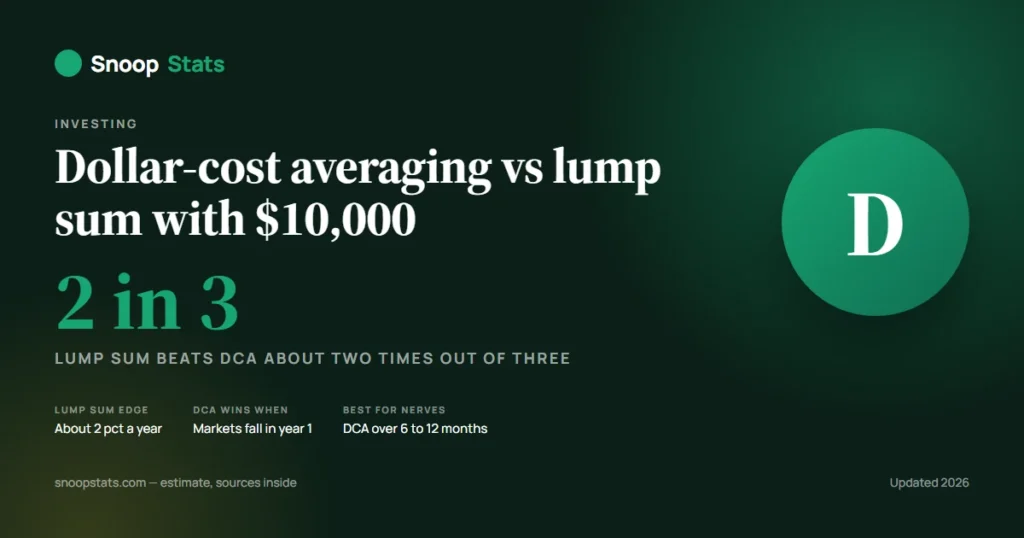
You have $10,000 sitting in a savings account and you want it in an index fund. The question everyone asks is whether to invest it all today (lump sum) or spread it over several months (dollar-cost averaging, or DCA). The honest answer from the data: lump sum wins more often, DCA hurts less when it loses, and the difference is smaller than the internet argues about. Here is how to decide.
What the historical data shows
Vanguard’s well-known studies of US, UK and Australian markets, repeated by several other firms since, reach the same conclusion: investing a lump sum immediately beat spreading it over 12 months roughly two-thirds of the time, by an average of around 2 percent over the following year. The reason is simple. Markets go up more often than they go down, so money that is invested earlier is usually invested at a lower price.
| Approach | Wins how often (historical) | Typical advantage when it wins | Typical loss when it loses |
|---|---|---|---|
| Lump sum today | About 65 to 70 percent of periods | 2 to 3 percent over a year | Larger drawdown if the market falls right away |
| DCA over 6 to 12 months | About 30 to 35 percent of periods | Avoids buying at a peak | Cash drag: money sits uninvested in a rising market |
What that looks like with $10,000
Using a broad stock index returning an average 8 percent a year:
| Scenario | Lump sum after 12 months | DCA ($833 a month) after 12 months |
|---|---|---|
| Average year, steady rise | About $10,800 | About $10,430 |
| Market falls 15 percent in month 2, recovers by month 12 | About $10,000 | About $10,650 |
| Market rises 20 percent in the first half, flat after | About $12,000 | About $11,000 |
DCA only wins clearly in the scenario where the market drops soon after you start. Since nobody can predict that, the expected-value answer is lump sum.
Why people choose DCA anyway
Because investing $10,000 the day before a 15 percent drop feels terrible, and people who feel terrible sell at the bottom. The real risk with lump sum is not the maths, it is your reaction. If a sharp early loss would make you pull the money out, DCA is the better plan for you even though it has a lower expected return, because the plan you stick with beats the plan you abandon.
A simple decision rule
- If $10,000 is less than about a third of your total investments, lump sum. A bad month on a small addition will not change your behaviour.
- If $10,000 is most of your savings, or it is your first investment, DCA over 6 months. Automate it so you do not decide each month.
- Never DCA over more than 12 months. Beyond that, the cash drag outweighs any comfort.
- Whichever you pick, keep an emergency fund separate. This money should not be your only cash.
How to set up DCA properly
Put the $10,000 in a high-yield savings account (so it earns 3.5 to 4.5 percent while it waits), then set an automatic monthly buy of $1,667 for six months into the same index fund. Do not watch the price. The point of automation is to remove the decision.
What both approaches agree on
- Low-cost, broad index funds beat picking stocks for almost everyone.
- Time in the market matters more than the entry point over 10-plus years.
- Fees and taxes matter more than the DCA versus lump sum decision. Use a tax-advantaged account first.
DCA in a Down Market vs a Bull Market
Dollar-cost averaging behaves differently depending on the market it lands in, which is part of why the historical comparison to lump sum investing is closer than people expect. In a declining or choppy market, spreading purchases out buys more shares at lower prices as the market falls, which softens the emotional and financial impact of a downturn compared to putting the full amount in on day one. In a rising market — which is the more common condition historically — DCA underperforms lump sum investing precisely because later purchases happen at higher prices than an all-at-once investment would have captured.
The practical takeaway is that DCA is not a strategy for maximizing returns; it is a strategy for managing regret and behavior. Someone who invests $10,000 at once and watches the market drop 15% the next month is statistically more likely to panic-sell than someone who only had a fraction of that amount exposed at the time of the drop.
Common DCA Mistakes to Avoid
The most common mistake is abandoning the schedule during a downturn — pausing contributions right when the market is offering lower prices defeats the entire purpose of the strategy. The second is over-engineering the schedule with too many small purchases spread across too long a period; stretching a lump sum out over two or three years, rather than the more commonly studied six-to-twelve-month window, means more of the money sits in cash earning little while waiting to be deployed, which is its own form of opportunity cost.
The third mistake is treating DCA as a permanent investing philosophy rather than a one-time tool for deploying a specific lump sum. Once the original amount is fully invested, ongoing contributions from a regular paycheck are already a form of dollar-cost averaging by default — there is no need to keep “spreading out” money that arrives incrementally in the first place.
Tax Considerations for Lump Sum vs DCA
Neither lump sum investing nor dollar-cost averaging changes how investment gains are taxed once money is invested — both are subject to the same capital gains rules based on how long each specific purchase is held before being sold. Because DCA creates multiple purchase dates instead of one, it does create more individual “lots” of shares, each with its own cost basis and holding period, which can add a small amount of bookkeeping complexity when it eventually comes time to sell.
For money invested inside a tax-advantaged account like a 401(k) or IRA, this distinction barely matters, since those accounts do not trigger a taxable event on each individual purchase. For a taxable brokerage account, most investors find that modern brokerage platforms track cost basis per lot automatically, making this a minor consideration compared to the more important question of overall strategy and risk tolerance.
When Lump Sum Almost Always Wins
Historical research consistently shows lump sum investing outperforming DCA in roughly two out of every three rolling time periods, simply because markets rise more often than they fall over any extended stretch of history. Money sitting in cash while being gradually deployed through a DCA schedule is money not participating in that more common upward drift, which is the core mathematical cost of choosing DCA.
The exception that matters most in practice is psychological rather than mathematical: an investor who would panic-sell a lump sum investment after a 10% drop, locking in a real loss, is often better off accepting DCA’s lower expected return in exchange for a smaller chance of that panic-driven mistake. The “right” choice depends more on how someone would actually behave during a downturn than on which approach wins in a spreadsheet.
DCA for Retirement Accounts vs a Windfall
Regular retirement account contributions from a paycheck are already a form of dollar-cost averaging by default, since a fixed amount is invested at whatever price the market happens to be at on each pay date — there is no separate decision to make there. The DCA vs lump sum question really only applies to a distinct pool of money that arrives all at once: an inheritance, a bonus, the proceeds from selling a home, or a rollover from a previous employer’s retirement plan.
For a rollover specifically, many investors choose lump sum investing back into the market simply to avoid an extended period sitting in cash and missing the account’s intended asset allocation, treating the rollover as a continuation of an existing strategy rather than a fresh decision that needs its own DCA schedule.
How to Choose Your DCA Interval
Most of the historical research on DCA studies periods between six and twelve months, splitting a lump sum into equal monthly or quarterly purchases over that window. Shorter intervals, like spreading a lump sum over three months, more closely resemble a lump sum investment and reduce the psychological benefit that makes DCA appealing in the first place. Longer intervals, like two or three years, leave more money sitting in cash for an extended period, increasing the opportunity cost of the strategy without meaningfully increasing its emotional benefit beyond what a 6-to-12-month schedule already provides.
A monthly cadence over six to twelve months tends to be the practical sweet spot: frequent enough to smooth out short-term volatility, but not so drawn out that it meaningfully sacrifices the higher expected return of getting invested sooner.
What If the Market Doesn’t Recover Quickly
The scenario DCA is specifically designed to soften is a market that falls significantly right after a lump sum is invested and takes years to recover — Japan’s extended market stagnation and the years following the 2008 financial crisis are the historical examples most often cited. In those specific windows, DCA meaningfully outperformed lump sum investing, since later purchases bought in at depressed prices rather than locking in a single high entry point before a prolonged downturn.
These extended-downturn scenarios are the exception rather than the rule across market history, which is why lump sum wins more often over a large sample of rolling periods. But for an investor who is specifically worried about bad timing — investing right before a prolonged slump rather than a short-lived dip — DCA directly addresses that particular fear in a way a purely statistical “lump sum wins most of the time” argument does not fully resolve.
A Hybrid Approach Worth Considering
Investors uncomfortable with an all-or-nothing choice often split the difference: investing half the lump sum immediately and dollar-cost averaging the remainder over the following six months. This captures most of lump sum’s statistical advantage — half the money starts working right away — while still providing some of DCA’s psychological cushion against a downturn immediately after investing.
There is no research showing this hybrid beats either pure strategy on average, but it is a reasonable compromise for someone who finds the all-at-once decision genuinely stressful, since sticking with a plan comfortably is often more valuable in practice than optimizing for a small statistical edge.
Making the Decision With Confidence
Neither DCA nor lump sum is objectively “correct” for every investor with $10,000 to put to work — the honest answer depends on how much the statistical edge of lump sum investing is worth compared to the peace of mind DCA provides against a poorly timed entry. Whichever approach gets chosen and actually followed through to completion will, in almost every case, beat the third option of leaving the money in cash indefinitely while waiting for a “better” time to decide.
Revisiting this decision only matters once — after the lump sum is fully deployed, the far more important habit is simply staying invested through the normal ups and downs that follow, regardless of which method was used to get there.
People Also Ask
Is it better to invest a lump sum or dollar-cost average?
Historically, a lump sum wins about two-thirds of the time by roughly 2 percent a year. DCA is better if a sharp early loss would make you sell.
How long should dollar-cost averaging last for $10,000?
Six months is a good balance; never more than twelve. Longer periods leave too much cash uninvested.
Does DCA reduce risk?
It reduces the risk of buying everything at a peak, but it adds the risk of missing gains. Over long periods the two roughly cancel; DCA mainly reduces regret, not risk.
What if the market is at an all-time high?
Markets are at all-time highs a large share of the time, and returns after all-time highs have historically been similar to returns from any other point. It is not a reason to wait.
Vanguard’s own research paper on dollar-cost averaging versus lump-sum investing is the source most advisors cite, and once your $10,000 is invested, revisiting your 50/30/20 budget keeps future contributions on track.