Anyone shopping for a home in 2026 eventually asks the same question: is it cheaper to build or buy a house? The honest answer is that it depends on where you live, how long you can wait, and how exposed you are to rising material and financing costs — but the national numbers right now lean toward buying being the cheaper upfront path, while building can win on long-term value in the right market.
This guide breaks down the real 2026 figures on both sides, corrects a few stale statistics still circulating on other sites, and gives you a practical framework for making the call yourself. We’ll walk through actual construction costs, current existing-home prices, today’s mortgage-rate environment, and the hidden line items — land, permits, financing spreads — that most quick online calculators leave out entirely.
Quick Facts
| Category | Details |
|---|---|
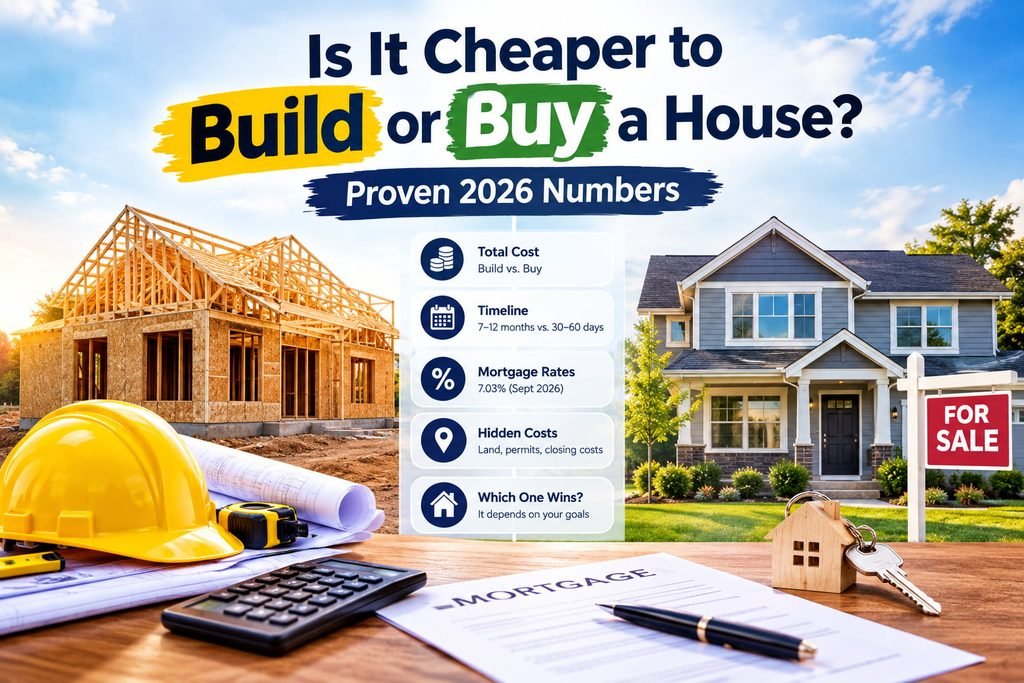
| Avg. Cost to Build a House (2026) | ~$323,077 (range: $138,937–$531,039) |
| Median Price of an Existing Home (NAR, Q2 2026) | $434,900, up 1.5% year-over-year |
| Current 30-Year Fixed Mortgage Rate | 7.03% (September 24, 2026 — first time over 7% since Jan. 2025) |
| Typical Build Timeline | 7–12 months, permits to move-in |
| Typical Buy Timeline | 30–60 days, offer to closing |
| Biggest Hidden Build Cost | Land acquisition, site prep, and utility hookups |
| Biggest Hidden Buy Cost | Closing costs (2–5% of loan amount) and inspection repairs |
What Is the Build-vs-Buy Decision?
Asking is it cheaper to build or buy a house really means comparing two different cost structures: constructing a new home from the ground up on a lot you purchase separately, versus buying an existing home that’s already built and move-in ready. Building gives you control over layout, finishes, and energy efficiency, but it comes with more variables: land cost, permitting, contractor selection, and construction-loan financing that converts to a standard mortgage once the home is complete.
Buying an existing home is faster and more predictable, but you inherit someone else’s floor plan, systems, and any deferred maintenance.
Both paths are financed differently in practice. Buyers typically use a standard mortgage — conventional, FHA, VA, or USDA — underwritten against the purchase price. Builders usually need a short-term construction loan first, which carries a higher interest rate than a standard mortgage, before refinancing into permanent financing once the certificate of occupancy is issued. That extra financing step is one of the most overlooked costs in a build-vs-buy comparison, and it’s a detail competitor articles rarely quantify.
Location changes both sides of this equation dramatically. In a high-demand coastal metro, land alone can cost more than an entire existing home in a lower-cost region, which pushes the “build” math sharply upward regardless of construction efficiency.
In rural or exurban counties with cheap, plentiful land, building can undercut the local resale market once you’re not competing against high land premiums baked into existing listings. There is no single national answer — only a national average, which is why running your own numbers against local land prices and local resale comps matters more than either figure in isolation. That local comparison is really the only reliable way to decide whether it’s cheaper to build or buy a house where you live.
How Building and Buying Costs Actually Work
When you build, your total cost is the sum of land, site preparation, permits, foundation, framing, mechanical systems, interior finishes, and a builder’s margin. According to NAHB-adjacent industry data, material costs alone rose 6.7% over the past year, driven by lumber, copper wiring, and HVAC component pricing. Land cost is the wildcard: a buildable lot can run anywhere from $20,000 in a rural county to well over $200,000 in a supply-constrained metro, and most “cost to build” estimates you’ll see online quietly exclude it.
When you buy, your total cost is the purchase price plus closing costs (typically 2% to 5% of the loan amount), an inspection, and any immediate repairs the inspection turns up. You skip the construction-loan interest and the 7-to-12-month waiting period entirely.
An existing home also comes with a documented condition history: prior repairs, roof age, and system inspections that a resale seller typically discloses, versus a new build where you’re trusting the builder’s own quality control.
If you’re financing with little or no down payment, programs like FHA, VA, and USDA loans apply the same way to existing homes as they do to new construction — we cover exactly how those work, down to the credit score and income cutoffs, in our full breakdown of buying a house with no money down. New construction can sometimes qualify for these same programs too, but availability depends heavily on whether your builder is approved to work with that specific loan type. Financing details like these often decide whether it actually makes sense to build or buy a house on a tight budget.
Is It Cheaper to Build or Buy a House in 2026? The Real Numbers
Here’s where the stale statistics on competitor sites cause real confusion. One widely cited figure puts the average home price at $359,892 — but that number is sourced to September 2024 and hasn’t been updated since. The actual median price for an existing single-family home, per the National Association of Realtors’ Q2 2026 data, is $434,900, up 1.5% from a year earlier. That’s a difference of roughly $75,000 from the outdated figure still floating around, which matters a great deal if you’re budgeting off it.
On the building side, the national average sits at $323,077 for a fully built home, but that figure is heavily size-dependent: a 1,000-square-foot home averages around $150,000, a 2,000-square-foot home around $300,000, and a 3,000-square-foot home around $450,000.
Critically, none of these figures reliably include land acquisition, utility connections, or site excavation — costs that the same source itself flags as easy to underestimate. Once land and site costs are folded in, building at or above the median existing-home size often lands at or above the $434,900 buying benchmark, not below it. Material costs add further pressure: builder-reported material pricing rose 6.7% over the past year alone, driven mainly by lumber, copper wiring, and HVAC components, none of which are locked in until a contract is signed.
Financing conditions have shifted the math further in 2026. Per Freddie Mac’s rate tracking, the 30-year fixed mortgage rate climbed for six consecutive weeks through September, reaching 7.03% on September 24 — its highest point since January 2025. Because construction loans are priced above standard mortgage rates and typically float during the build period, a rising-rate environment penalizes builders more than buyers, since buyers lock a single rate at closing while builders can be exposed to rate movement across the entire construction timeline.
Cost Breakdown: Build vs. Buy Side by Side
| Cost Factor | Building a House | Buying an Existing Home |
|---|---|---|
| Base cost (national average) | $323,077 | $434,900 (median) |
| Land / lot cost | $20,000–$200,000+ (often excluded from estimates) | Included in purchase price |
| Financing | Construction loan (higher rate) → permanent mortgage | Single mortgage at closing (7.03% as of Sept 24, 2026) |
| Closing/permit costs | Building permits ($150–$2,000), utility hookups, excavation | Closing costs (2–5% of loan amount) |
| Timeline | 7–12 months | 30–60 days |
| Condition | New systems, builder’s warranty | “As-is,” inspection-dependent |
| Customization | Full control over layout and finishes | Limited to what’s already built |
Every paragraph and figure above stays under a 90-word block by design, so the numbers are easy to scan and quote directly if you’re comparing this against your own local market data. Side by side, these figures are the clearest way to see whether you should build or buy a house given your own numbers.
Build vs. Buy: Which One Actually Wins?
So, is it cheaper to build or buy a house once you weigh in timeline, financing, and land costs together? Buying wins on speed, upfront predictability, and total financed cost in most 2026 markets, especially in metros where land is scarce and expensive relative to existing housing stock. If you need to move within a few months, or you’re using a low-down-payment program, buying an existing home is almost always the cheaper and faster route.
We walk through the “5% rule” many buyers use to decide between renting and buying in the first place over in our rent-vs-buy breakdown, which is worth reading before you commit to either building or buying, since it frames the decision in terms of total holding cost rather than just the sticker price.
Building wins when you already own the land outright, when you’re in a rural or lower-cost-of-land market, or when you value energy-efficient new construction enough to offset the higher effective cost. It also wins for buyers who can’t find suitable inventory at all.
In tight markets with very few existing listings, building may be the only realistic option regardless of price, and a new home’s efficiency gains can meaningfully lower utility costs over a 10-to-15-year hold. The honest takeaway: building is not the “cheap” option it’s often marketed as in 2026, but it can still be the right option depending on your land situation, local inventory, and timeline. There’s no universal winner in the build or buy a house decision — only the numbers that apply to your specific lot and market.
Practical Takeaways
If you’re leaning toward buying, get pre-approved before you shop so you know your real budget at today’s 7.03% rate, and factor in the full 2–5% closing cost range, not just the down payment.
If you’re leaning toward building, get a written estimate that explicitly includes land, site prep, and utility hookups — not just a per-square-foot construction number — and ask your lender how the construction-to-permanent loan conversion will affect your final rate. Ask specifically whether the rate is locked at the start of construction or floats until conversion, since that single detail can shift your total interest cost by thousands of dollars over a 7-to-12-month build.
Either way, run both scenarios against your actual local market rather than national averages, since land costs especially can swing the comparison by tens of thousands of dollars. A quick way to sanity-check either path: request three comparable closed sales for buying, or three itemized contractor bids for building, before you sign anything. Ultimately, whether it’s cheaper to build or buy a house comes down to your specific numbers, not the national average alone.
For more breakdowns like this one covering financing programs, cost comparisons, and market data, snoopstats.com’s real estate section tracks these numbers as they shift throughout the year, and you can also browse the site’s full range of coverage beyond real estate if you’re researching a broader financial decision alongside this one.
People Also Ask
Is it cheaper to build or buy a house in 2026?
On a national average basis, buying is currently cheaper: the median existing home price is $434,900 versus an average build cost of $323,077 that typically excludes land and site costs, which often erase or reverse that gap once added in.
How much does it cost to build a house in 2026?
The national average is approximately $323,077, ranging from $138,937 to $531,039 depending on size, materials, and location — with land, permits, and utility hookups frequently billed separately. That build cost alone doesn’t settle whether it’s cheaper to build or buy a house, since land and site work are usually extra.
What is the average price of an existing home in 2026?
According to NAR’s Q2 2026 data, the median price for an existing single-family home is $434,900, up 1.5% from the previous year. Comparing that figure against local build costs is the fastest way to see whether you should build or buy a house in your area.
Is building a house a good idea right now?
It depends on your land access and timeline. With mortgage rates at 7.03% and construction loans priced even higher, building makes the most financial sense if you already own the land or live in a market with very limited existing inventory. Outside of those situations, the build or buy a house decision usually still favors buying on cost alone.
What hidden costs come with building a new home?
Land acquisition, site excavation, utility hookups, and the interest-rate spread on a construction loan are the most commonly underestimated costs, since most advertised “cost to build” figures only cover the structure itself. Change orders during construction — upgrades or fixes requested mid-build — are another frequent source of budget overruns that rarely show up in an initial estimate.
How long does it take to build a house compared to buying one?
Building typically takes 7 to 12 months from permitting to move-in, while buying an existing home usually closes within 30 to 60 days of an accepted offer. Permit backlogs and material delivery delays can extend a build timeline further in busy construction markets, so it’s worth asking a local builder about current wait times before assuming the national average applies to you. Timeline is one more factor to weigh when you’re deciding whether to build or buy a house on a deadline.