Most articles on how to buy a house with no money either oversell it as a guaranteed shortcut or bury the real options under vague advice to “ask about assistance programs.” Neither approach actually helps. The honest answer is that buying a house with no money down is genuinely possible in 2026, through a specific, well-documented set of loan programs and strategies — but it rarely means paying absolutely nothing at closing.
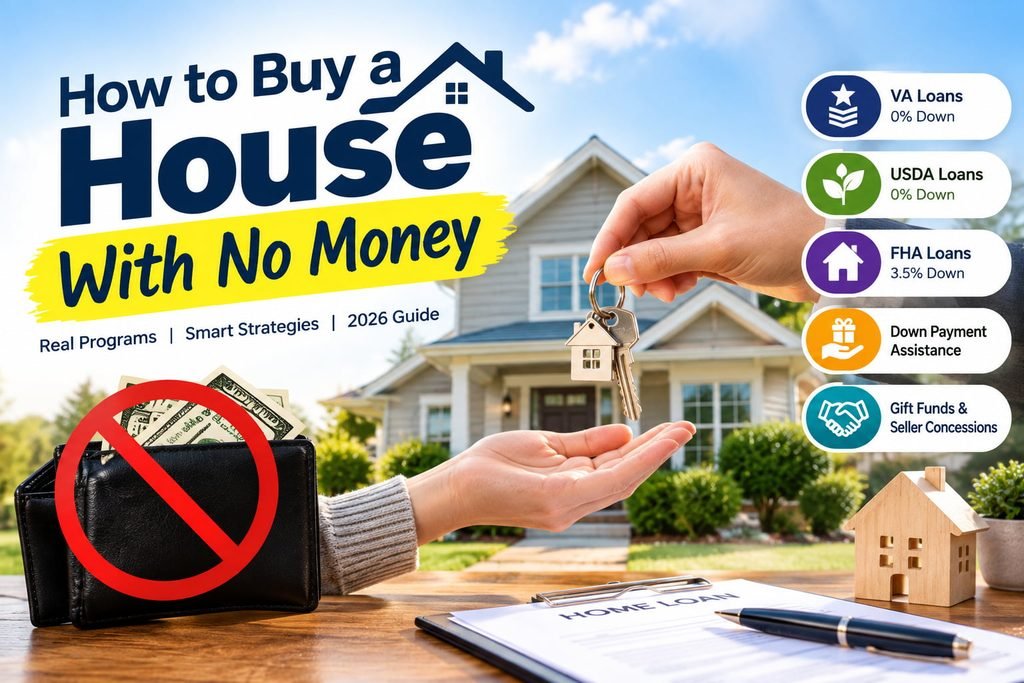
If you’re wondering how to buy a house with no money down right now, the short answer is: VA loans and USDA loans require no down payment at all for eligible borrowers, while FHA and conventional loans can be paired with down payment assistance, gift funds, or seller concessions to get your out-of-pocket cost close to zero.
Quick Facts
| Category | Details |
|---|---|
| Best For | Veterans, rural/suburban buyers, first-time buyers with limited savings |
| Zero-Down Loan Options | VA loans, USDA loans |
| Low-Down Loan Options | FHA (3.5% down), Conventional 97/HomeReady/Home Possible (3% down) |
| Typical Credit Score Needed | 580–640+, depending on the program |
| Key Assistance Tools | Down payment assistance grants, gift funds, gift of equity, seller concessions, lender credits |
| Current Avg. 30-Year Mortgage Rate | 7.23% (late September 2026, a one-year high) |
| Estimated Timeline | 30–60 days from pre-approval to closing |
| Risk Level | Moderate to high without a cash reserve for repairs and unexpected costs |
What Is Buying a House With No Money?
Buying a house with no money means purchasing a home without using your own savings for the down payment, either because the loan program itself doesn’t require one or because assistance programs, gifts, or seller-paid credits cover it instead.
It does not usually mean a completely cost-free purchase. Closing costs — typically 3% to 5% of the loan amount — still apply in almost every case, and buyers need a plan for covering those even when the down payment itself is zero.
How Zero-Down and Low-Down Financing Actually Works
Zero-down and low-down mortgages work by shifting who guarantees the lender’s risk when a borrower puts little or nothing of their own money into a purchase. A VA loan is backed by the U.S. Department of Veterans Affairs, and a USDA loan is backed by the U.S. Department of Agriculture, which is why both can legally offer 100% financing without requiring private mortgage insurance in the traditional sense.
FHA and conventional loans work differently. They still require a down payment, but a low one — as little as 3.5% for FHA and 3% for conventional programs like HomeReady and Home Possible. The gap between that low down payment and zero is where down payment assistance, gift funds, and seller concessions come in, effectively covering what the borrower would otherwise need to save.
The Real Ways to Buy a House With No Money in 2026
VA loans remain the most straightforward zero-down option for eligible veterans, active-duty service members, and some surviving spouses. According to the Department of Veterans Affairs, VA loans require no down payment and no private mortgage insurance, though most borrowers pay a one-time VA funding fee of 2.15% on a first-time purchase with no money down, rising to 3.30% on subsequent uses. Veterans with a service-connected disability rating of 10% or higher, along with Purple Heart recipients and surviving spouses receiving Dependency and Indemnity Compensation, are exempt from that fee entirely.
USDA loans offer the other true zero-down path, aimed at buyers purchasing in eligible rural and suburban areas, generally places with a population under 35,000. In 2026, income limits for most areas fall between roughly $112,450 for a 1-4 person household and $148,450 for a 5-8 person household, based on 115% of the area’s median income. USDA loans charge a 1.00% upfront guarantee fee and a 0.35% annual fee instead of traditional mortgage insurance, and typically require a credit score of 640 or higher.
FHA loans paired with down payment assistance is how most no-money-down buyers without VA or USDA eligibility actually get there. FHA loans require just 3.5% down with a 580+ credit score, and programs like the Chenoa Fund provide that entire 3.5% to 5% as either a forgivable grant or a repayable second loan, with a minimum credit score around 600 and no income limits, available in every state except New York.
Gift funds and gift of equity let family members cover part or all of a down payment directly, provided the money comes with a signed gift letter documenting the amount, the relationship, and confirmation that it never needs to be repaid. A gift of equity works similarly when a family member sells you a home below market value, with the difference counted toward your down payment instead of changing hands as cash.
Seller concessions and lender credits are negotiated rather than automatic. A seller can agree to cover part of your closing costs, particularly in a buyer’s market, and a lender can offer a credit toward those same costs in exchange for a slightly higher interest rate. Neither reduces your loan’s down payment requirement, but both reduce the actual cash you need at the closing table.
In practice, most people who figure out how to buy a house with no money down end up combining two or three of these tools rather than relying on just one, since a zero-down loan still leaves closing costs to cover, and a low-down loan still leaves a down payment gap to fill.
Buying a House With No Money in 2026: What’s Changed
The single biggest factor shaping no-money-down buying in 2026 is where mortgage rates sit. The average 30-year fixed rate hit 7.23% in late September 2026, a one-year high, after rates had been trending down through late 2025 before the Federal Reserve raised its target range again in September.
That matters directly for anyone buying with no money down: a larger loan balance combined with a higher rate means a meaningfully bigger monthly payment than the same purchase would have carried a year earlier, with essentially no equity cushion if home values dip. FHA loan limits also rose for 2026, up to $541,288 in most areas and as high as $1,249,125 in expensive counties, which widens what’s technically financeable with a low down payment, even as monthly costs climb.
Cost Breakdown: What “No Down Payment” Still Costs
Closing costs (3%–5% of the loan amount): Covers the lender’s origination fee, title insurance, recording fees, and similar charges that exist independent of your down payment.
Appraisal and inspection fees: Typically $400 to $800 combined, paid upfront regardless of how the rest of the purchase is financed.
Upfront mortgage insurance or funding fees: The VA funding fee, USDA guarantee fee, or FHA upfront mortgage insurance premium, each calculated as a percentage of the loan amount and usually rolled into the loan itself.
Prepaid escrow items: Property taxes and homeowners insurance often need several months prepaid into an escrow account at closing, an expense separate from the down payment entirely.
Zero-Down vs. Low-Down Options Compared
| Program | Down Payment | Typical Credit Score | Mortgage Insurance |
|---|---|---|---|
| VA Loan | 0% | No official minimum, lenders often want 580–620 | None (funding fee instead) |
| USDA Loan | 0% | 640+ | 1.00% upfront + 0.35% annual |
| FHA Loan | 3.5% (or 10% with lower credit) | 580+ (500–579 with 10% down) | Upfront + annual, often life of loan |
| Conventional 97 / HomeReady / Home Possible | 3% | 620+ | Cancellable at 20% equity |
Practical Takeaways
Get pre-approved before house hunting, not after, so you know exactly which zero-down or low-down programs you actually qualify for rather than guessing.
Work on your credit score early. The difference between a 580 and a 640 credit score can change which programs are available to you and how much you’ll pay in fees or insurance.
Budget for cash reserves even at $0 down. A no-money-down loan still leaves you exposed to repair costs, moving expenses, and the first mortgage payment, all due close together.
Get gift fund documentation right the first time. Lenders require a clear paper trail, and a missing gift letter or undocumented deposit can delay or derail closing.
Negotiate seller concessions when the market allows it. In a slower local market, asking a seller to cover part of your closing costs is a normal, reasonable request, not an unusual one.
Be realistic about payments at today’s rates. At 7.23%, financing 100% of a home’s price costs meaningfully more per month than it did when rates were lower, so run the numbers before committing.
Talk to a HUD-approved housing counselor if you’re unsure where to start. Many offer free guidance on down payment assistance options specific to your state and county.
None of these steps require a large emergency fund or years of saving, which is exactly why so many people search for how to buy a house with no money instead of assuming a 20% down payment is the only path to homeownership.
For a broader look at how income, assets, and major purchases like a first home fit into your overall financial picture, Snoopstats covers a wide range of personal finance topics worth reading alongside this guide.
People Also Ask
Can you really buy a house with no money down in 2026?
Yes, primarily through VA loans and USDA loans for eligible borrowers, or through FHA and conventional loans combined with down payment assistance or gift funds.
What loans allow you to buy a house with no money down?
VA loans and USDA loans both offer 0% down payment options for qualifying borrowers.
Who qualifies for a USDA loan?
Buyers purchasing in eligible rural or suburban areas, with household income generally under 115% of the area median, and a credit score of 640 or higher.
Who qualifies for a VA loan with no down payment?
Eligible veterans, active-duty service members, and certain surviving spouses with a valid Certificate of Eligibility.
What is down payment assistance and how does it work?
It’s a grant or second loan, sometimes forgivable, that covers part or all of a down payment, often paired with an FHA loan.
What is a gift of equity?
When a family member sells you a home below market value, with the price difference counted toward your down payment instead of cash changing hands.
Do you still pay closing costs with a no-money-down loan?
Yes, closing costs typically run 3% to 5% of the loan amount and are separate from the down payment itself.
What credit score do you need to buy a house with no money down?
It varies by program, from around 580 for FHA loans to 640 or higher for USDA loans, with no official VA minimum though most lenders want 580–620.
Is buying a house with no money down a bad idea?
Not inherently, but it leaves less equity cushion and higher monthly payments, so it works best with a solid income and an emergency cash reserve.
What is the difference between FHA and USDA loans?
FHA loans require a small down payment and are available anywhere, while USDA loans require zero down but only apply in eligible rural and suburban areas.
What are current mortgage rates in 2026?
The average 30-year fixed rate reached 7.23% in late September 2026, a one-year high.
How does the Chenoa Fund down payment assistance program work?
It provides 3.5% to 5% of an FHA loan’s down payment as either a forgivable grant or a repayable second loan, available nationwide except New York.
Related Real Estate Guides
This is a new category for the site, so these are suggested topics for future guides rather than live links yet: a breakdown of first-time homebuyer programs by state, a side-by-side comparison of FHA versus conventional loans, a guide to figuring out how much house you can actually afford in 2026, an explainer on private mortgage insurance and how to get rid of it, and a rent-versus-buy breakdown for today’s rate environment.