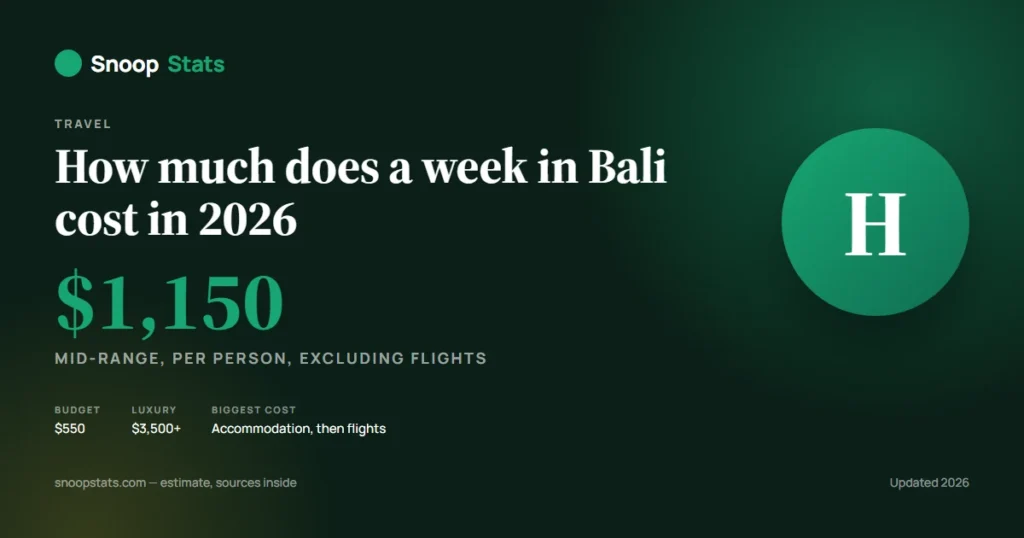
How much does a week in Bali cost? A week in Bali costs roughly $550 per person on a backpacker budget, $1,150 mid-range, and $3,500 or more for luxury, excluding flights. Those totals come from 2026 prices for accommodation, food, transport, activities and the fees that most guides leave out. Here is the full breakdown so you can build your own number.
The three budgets side by side (7 days, per person)
| Cost | Budget | Mid-range | Luxury |
|---|---|---|---|
| Accommodation (7 nights) | $105 (hostel or guesthouse, $15) | $455 (boutique hotel or villa share, $65) | $1,750 (resort or private villa, $250) |
| Food and drink | $105 (warungs, $15 a day) | $245 (mix of cafes and restaurants, $35) | $560 (restaurants, cocktails, $80) |
| Transport | $70 (scooter rental plus fuel) | $140 (Grab, Gojek, one private driver day) | $420 (private driver, airport transfers) |
| Activities | $60 (temples, beaches, one tour) | $150 (day trips, surf lesson, spa) | $400 (private tours, diving, spa days) |
| Visa on arrival and tourist levy | $42 | $42 | $42 |
| SIM, tips, incidentals | $40 | $80 | $150 |
| Travel insurance | $30 | $40 | $60 |
| Total, excluding flights | About $450 to $600 | About $1,000 to $1,300 | $3,300 and up |
Accommodation: the biggest lever
Where you stay decides half the budget. In 2026, hostels in Canggu and Ubud run $10 to $20 a night, guesthouses (homestays) $20 to $35, boutique hotels and shared villas $50 to $90, and private pool villas from $120 to $400. Seminyak and Uluwatu are the most expensive areas; Ubud and the north are cheapest. Booking a villa with friends often costs less per person than a mid-range hotel.
Food: $15 a day is realistic
A meal at a local warung is $2 to $4. A cafe breakfast in Canggu is $6 to $9. A restaurant dinner with a drink is $15 to $30. Alcohol is the budget breaker: imported spirits are taxed heavily, so a cocktail is $8 to $14 while a local Bintang beer is $2 to $3.
Getting around
Scooter rental is $5 to $8 a day plus about $1.50 a day in fuel; you need an international driving permit and a helmet, and insurance often will not cover you without them. Ride-hailing apps (Grab, Gojek) are cheap for short hops, $1 to $4. A private driver for a full day of sightseeing is $45 to $60 for the car, which is the best value for two or more people.
Fees people forget
- Visa on arrival: about $32 (500,000 rupiah), valid 30 days, extendable once.
- Bali tourist levy: about $10 (150,000 rupiah), paid online before or on arrival.
- Temple entry: $3 to $5 each, sarong included.
- Airport transfer if you skip the apps: $20 to $30 to Canggu or Seminyak.
- ATM fees: $3 to $5 per withdrawal from your bank plus local fees; take out larger amounts less often.
How Much Does a Week in Bali Cost With Flights?
Return economy fares to Denpasar in 2026: about $400 to $700 from Australia, $600 to $1,000 from Europe, $900 to $1,400 from the US, and $150 to $350 from Singapore or Kuala Lumpur. Shoulder season (April to June, September to October) is 20 to 30 percent cheaper than July, August and the Christmas period.
A sample mid-range week for two people
Three nights in Ubud in a guesthouse with a pool ($55), four nights in a shared villa in Canggu ($70), one private driver day for temples and rice terraces ($55), a surf lesson each ($35), a couple’s spa afternoon ($60), cafe breakfasts and warung dinners with two restaurant nights, and Gojek rides. Total: about $2,200 for two, or $1,100 each, plus flights.
Best Time of Year to Visit for the Budget
Bali’s wet season, roughly November through March, consistently produces the lowest prices on flights, villas, and tours, since fewer tourists are willing to risk daily rain showers. Outside of the Christmas and New Year peak, this period can bring hotel discounts of 30 to 40 percent compared to July and August, even though the rain is typically short, heavy afternoon showers rather than an all-day washout.
For travelers who want lower prices without the rain risk, the shoulder months of May, June, September, and October offer a middle ground: mostly dry weather, thinner crowds at major attractions, and flight and hotel prices that are still meaningfully below the July-to-August and Christmas peaks. Avoiding the two peak windows entirely is the single biggest lever for cutting a Bali trip’s cost before even negotiating a single price on the ground.
Money-Saving Tips Locals Actually Use
Eating at a local warung — a small family-run food stall — instead of a tourist-oriented restaurant typically cuts a meal’s cost by half or more while often producing better, fresher food. Using the Gojek or Grab apps for transport instead of hailing a taxi on the street avoids the inflated “tourist price” that unmetered drivers frequently quote, and both apps show the fare before the ride starts.
Buying a local SIM card at the airport, rather than relying on expensive international roaming, costs only a few dollars for a week of data, which also makes it easier to use ride-hailing apps and compare prices in real time. At markets, quoted prices are typically a starting point for negotiation rather than a fixed price, and a polite counter-offer at roughly half the initial quote is a common, socially accepted starting point.
How Much Extra to Budget for Activities and Tours
Entry fees for temples, waterfalls, and rice terraces are typically small individually, often $2 to $5 per site, but they add up quickly across a week of sightseeing and are easy to underestimate when planning a daily budget. Guided activities like white-water rafting, a sunrise Mount Batur trek with a guide, or a snorkeling day trip typically run $25 to $60 per person, and booking these directly through a local operator rather than a hotel concierge or international booking app usually saves 20 to 40 percent on the same activity.
Spa treatments, a major draw for many visitors, are dramatically cheaper than Western prices — a full massage often costs $10 to $20 at a well-reviewed local spa versus $80 or more at a resort spa offering the identical service. Building a modest daily activities buffer into the trip budget, rather than treating each purchase as a surprise, keeps the overall week from running past the planned total.
Money You’ll Spend Without Realizing It
ATM fees are one of the most common budget leaks in Bali, since many local ATMs charge a withdrawal fee on top of whatever a home bank charges for international withdrawals — using a bank with reimbursed international ATM fees, or withdrawing larger amounts less frequently, meaningfully reduces this cost over a week-long trip. Bottled water, needed constantly given Bali’s tap water is not safe to drink, adds a small but real daily cost that a reusable bottle filled at accommodation refill stations can mostly eliminate.
Scooter rentals, a popular and cheap way to get around at roughly $5 to $8 a day, come with an easy-to-forget cost: an International Driving Permit is technically required, and renting without one can result in a large on-the-spot fine if stopped, along with voiding travel insurance in the event of an accident.
Is Bali Still Worth It in 2026?
Despite rising popularity and some price increases in tourist hubs like Canggu and Seminyak, Bali remains dramatically cheaper than comparable beach destinations in Europe, Australia, or the Caribbean, particularly for accommodation and food. A traveler willing to venture slightly beyond the most Instagrammed neighborhoods — toward areas like Ubud’s outskirts or the Bukit Peninsula — typically finds meaningfully lower prices without sacrificing much in scenery or amenities.
The value proposition holds up well as long as expectations match the destination: budget and mid-range travelers consistently report a strong value-for-money experience, while travelers seeking a five-star, all-inclusive-resort standard at rock-bottom prices are more likely to be disappointed, since that specific combination has become harder to find as the island’s tourism infrastructure has matured.
Solo vs. Couple vs. Group Trip Budgets
A solo traveler in Bali generally pays the most per person, since private villas, private drivers, and many tour packages are priced per unit rather than per head, meaning a single traveler absorbs the full cost of a room or car that a couple or group would split. Traveling as a couple roughly halves the accommodation and transport cost per person compared to solo travel, while a group of four or more sharing a villa can bring per-person accommodation costs down dramatically compared to booking individual hotel rooms.
Group travel does introduce its own cost dynamics: splitting a private driver for a full day of sightseeing among four people is far cheaper per person than four separate scooter rentals, but coordinating a larger group’s differing budgets and preferences can also lead to compromise spending — agreeing to a nicer restaurant or a pricier activity than a solo traveler would have chosen alone.
Packing and Pre-Trip Costs That Affect the Budget
Travel insurance, often overlooked in a destination-focused budget, typically costs $30 to $80 for a week-long trip depending on coverage level and age, and is worth treating as a fixed line item rather than an optional add-on given Bali’s popularity for adventure activities like surfing, diving, and scooter riding that carry real injury risk. A visa-on-arrival fee, required for many nationalities visiting Indonesia, adds a fixed cost that should be confirmed against current requirements before departure, since visa policies and fees do change periodically.
Vaccinations or preventive medications recommended for the region, a portable power bank for long travel days, and reef-safe sunscreen (increasingly required at some marine areas) are smaller pre-trip purchases that rarely appear in a destination cost breakdown but are worth budgeting for before departure rather than scrambling to buy at inflated airport prices.
Final Budget Sanity Check
Adding a 10 to 15 percent buffer on top of whichever total budget scenario fits best is a simple habit that absorbs the small surprises — a slightly higher taxi fare, an extra activity added on impulse — that inevitably show up on any week-long international trip regardless of how carefully it was planned in advance.
Treat every number in this guide as a planning range rather than an exact quote, confirm current prices closer to departure, and build in that small cushion so the trip stays enjoyable rather than becoming a source of budget stress once you’re already on the ground.
Bali has stayed a top budget-travel destination for a reason: it consistently delivers more experience per dollar than most comparable beach destinations, as long as the trip is planned with realistic numbers rather than the lowest figure seen in an old blog post.
Bookmark the current exchange rate and check it again a day or two before departure, since currency swings of even a few percentage points can shift every dollar figure in this guide slightly by the time you actually land.
With that in place, the range in this guide should stay accurate enough to plan against confidently.
People Also Ask
Is Bali expensive in 2026?
No by Western standards, but prices in Canggu and Seminyak have risen sharply. A comfortable week is about $1,000 to $1,300 per person before flights.
How much money should I bring to Bali for a week?
Budget travellers need about $550, mid-range about $1,150 and luxury $3,500 or more, excluding flights. Carry some cash for warungs and temples; cards work in most hotels and cafes.
What is the cheapest month to visit Bali?
February and March, followed by October and November. Expect afternoon rain but lower hotel prices.
Do I need travel insurance for Bali?
Yes. Scooter accidents and dengue are the two most common claims, and hospitals require payment or proof of cover upfront.
So, how much does a week in Bali cost in practice? Numbeo’s cost of living data backs up these ranges, and if you are saving up for the trip, our 50/30/20 budget guide shows where a Bali fund fits inside your monthly plan.