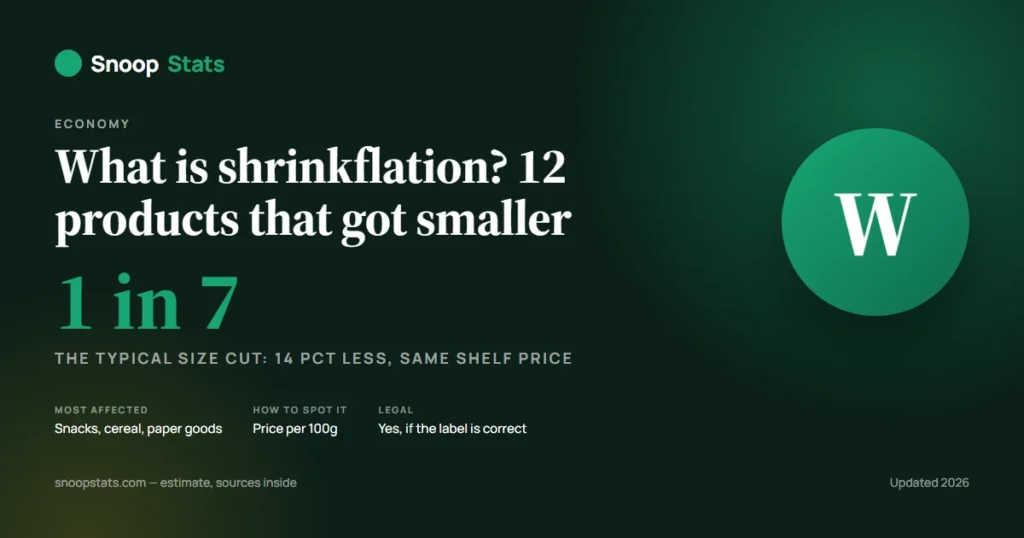
What is shrinkflation? It is Shrinkflation is the practice of reducing the size or quantity of a product while keeping the price the same, or raising it less than the size cut would justify. It is inflation that does not show up on the price tag. A bag of crisps goes from 150 grams to 130, a toilet roll loses 20 sheets, a chocolate bar gets thinner, and the shelf price does not move. This guide explains why it happens, where it happened most recently, and how to catch it in the aisle.
Why companies shrink products instead of raising prices
Consumer research consistently shows that shoppers notice price rises far more than size cuts. A 10 percent price increase can move people to a competitor; a 10 percent smaller package usually does not. So when input costs rise (ingredients, packaging, energy, wages), brands often cut size first and raise prices only when they have to. It is legal as long as the label states the correct weight or count.
Twelve categories where it showed up in 2025 and 2026
| Category | Typical change reported | Where it hides |
|---|---|---|
| Crisps and snack bags | 150g to 125 to 135g | Same bag size, more air |
| Chocolate bars | Thinner bars, fewer squares | Wrapper unchanged |
| Breakfast cereal | 500g to 450g boxes | Box same height, narrower |
| Toilet paper | Fewer sheets per roll, or narrower rolls | “Mega roll” labels shift meaning |
| Paper towels | Sheet count reduced | Sheet size also shrinks |
| Coffee | 1 lb cans now 10 to 12 oz | “Makes the same number of cups” claims |
| Ice cream | Half-gallon became 1.5 quarts, now 1.4 | Rounded tubs hide volume |
| Laundry detergent | Fewer loads per bottle | Bottle shape unchanged |
| Yoghurt cups | 170g to 150g | Same cup, deeper base |
| Frozen pizza | Lighter, smaller diameter | Box unchanged |
| Fast food portions | Fewer fries, smaller patties | No label to check |
| Streaming and subscriptions | Fewer screens, ad tiers, removed features | Service shrinkflation, same price |
The one number that exposes it
The unit price: the small line on the shelf label that says price per 100 grams, per litre or per 100 sheets. Supermarkets are required to show it in many countries and most US states. Compare that number, not the pack price, and shrinkflation becomes visible immediately. If the unit price rose while the pack price stayed the same, the pack got smaller.
How to protect your grocery budget
- Compare unit prices, always. Brand loyalty is what shrinkflation relies on.
- Store brands shrink less often, because the retailer controls the spec and competes on value.
- Buy by weight where you can: loose produce, deli counters, bulk bins.
- Keep a photo of the label of five products you buy every week. Check it every few months.
- Watch for “new look” or “new recipe” packaging. It often coincides with a size change.
Is shrinkflation slowing down?
As headline inflation cooled through 2025, the pace of new size cuts slowed, but almost none of the earlier cuts were reversed. Some brands have run “more for the same price” promotions to win back trust, and a few governments (France, South Korea, Hungary) now require retailers to flag shrunken products on the shelf. In most markets, though, the unit price is still the only reliable signal.
How to Spot Shrinkflation Before You Buy
The unit price — the small print on the shelf tag showing cost per ounce, per count, or per load — is the single most reliable tool for catching shrinkflation in real time, since package sizes can change while the price stays identical, but the unit price moves immediately. Comparing the unit price of a product to what it was on a previous receipt, or to a store-brand alternative, quickly reveals whether a “special edition” or “new look” package is quietly delivering less for the same money.
Package shape is another tell. A concave bottom on a bottle, a wider air gap inside a bag of chips, or a slightly shorter roll of paper towels are common ways manufacturers reduce content without changing the outer dimensions that shoppers glance at on a shelf. Keeping a mental note of a product’s usual weight or count — or checking it against the label the next few times it is purchased — is a low-effort habit that catches most shrinkflation before it affects the household budget.
Shrinkflation vs. Skimpflation: What’s the Difference
Shrinkflation and skimpflation are related but distinct cost-cutting tactics. Shrinkflation reduces the quantity of a product — fewer ounces, fewer sheets, fewer chips in the bag — while keeping the price and packaging largely the same. Skimpflation instead reduces the quality of a product or service while keeping the quantity constant: thinner fabric in clothing, less staff at a service counter, cheaper ingredients substituted into a recipe.
Both are responses to the same underlying pressure — rising input costs that companies are reluctant to pass on as a visible price increase — but skimpflation is generally harder for consumers to detect, since there is no number on the package to compare against a previous purchase. Reading reviews for changes in product quality over time is often the only practical way to catch skimpflation before a purchase.
Which Industries Are Hit Hardest
Packaged snack foods, cereal, coffee, and paper products have been among the most frequently cited categories for shrinkflation in recent years, largely because their packaging can be resized without changing the outer dimensions shoppers recognize on a shelf. Chocolate and candy are particularly common targets, since cocoa is a globally traded commodity subject to sharp price swings that manufacturers are often reluctant to pass on as a visible sticker-price increase.
Household staples like toilet paper and paper towels have also seen repeated sheet-count reductions, sometimes across multiple product cycles in a row, making the unit price rather than the roll count the only reliable way to compare value over time. Categories with high brand loyalty tend to see more shrinkflation than commodity categories, since manufacturers are betting that loyal customers will notice a shrinking package less than a rising price tag next to a cheaper competitor.
Does Shrinkflation Affect Inflation Statistics?
Government statistical agencies, including the U.S. Bureau of Labor Statistics, are supposed to account for package-size changes when calculating the Consumer Price Index, adjusting the tracked price per standardized unit rather than per package. In practice, critics argue that shrinkflation is harder to fully capture in official inflation data than a straightforward price increase, since it requires statisticians to notice and correctly adjust for every package-size change across thousands of tracked products.
That gap between measured inflation and consumers’ lived experience is part of why shrinkflation gets so much public attention: official statistics may show moderate price inflation while household grocery bills feel like they are rising faster, because part of the real cost increase is arriving as reduced quantity rather than a tracked price change.
How to Calculate the Real Price Increase
To find the true price increase behind a shrunken package, divide the new price by the new quantity, then divide the old price by the old quantity, and compare the two unit prices directly. A product that went from 16 ounces at $4.99 to 14 ounces at $4.99 did not stay the same price — its per-ounce cost rose from about 31 cents to about 36 cents, a roughly 14 percent increase disguised as an unchanged sticker price.
This calculation is exactly what unit pricing on the shelf tag is meant to simplify, but many shoppers still compare sticker prices out of habit rather than the smaller unit-price text beneath it. Getting in the habit of glancing at the unit price, especially for frequently purchased staples, turns shrinkflation from an invisible cost into a visible, comparable number.
What Regulators Are Doing About It
Some countries have moved toward requiring more explicit disclosure when a product’s size changes while its packaging design stays similar, aiming to make shrinkflation easier for consumers to notice at the point of purchase. In the United States, there is no federal law specifically requiring companies to announce a package downsizing, though existing truth-in-labeling and net-weight disclosure rules mean the new, smaller weight must still be accurately printed on the package.
Consumer advocacy groups have pushed for clearer “shrinkflation labels” that would flag a recent size reduction directly on the front of a package, similar to how some retailers voluntarily flag unit-price comparisons on shelf tags — but as of now, spotting shrinkflation remains mostly the shopper’s own responsibility rather than something regulation actively surfaces at the point of sale.
Is Shrinkflation Ethical or Just Business?
From a purely business standpoint, shrinkflation is a rational response to rising input costs — commodity prices, packaging, labor, and shipping have all risen in recent years, and companies face real pressure to protect margins without triggering the customer backlash a visible price increase can cause. Critics argue the practice crosses into deceptive territory specifically because it relies on customers not noticing, rather than being transparent about a cost increase the way a straightforward price hike would be.
Both things can be true at once: shrinkflation is a legal and common business practice, and it is also designed to be less noticeable than the price increase it functionally represents. Understanding that distinction is what turns shrinkflation from an abstract news topic into a practical reason to check unit prices rather than assuming a familiar package still contains what it used to.
Building a Shrinkflation-Resistant Grocery List
Store-brand and generic alternatives are generally less prone to stealth downsizing than heavily marketed national brands, since store brands compete primarily on price rather than brand loyalty and have less incentive to disguise a cost increase. Buying staples in bulk from warehouse clubs also sidesteps some shrinkflation risk, since bulk sizes are usually compared and repriced by weight more transparently than smaller retail packaging.
Keeping a short list of frequently purchased items’ usual weight or count — even a simple note on a phone — turns a vague sense that “this feels smaller” into a concrete comparison the next time that product is restocked.
Staying Ahead of It Going Forward
Shrinkflation is unlikely to disappear as long as commodity and input costs keep rising faster than companies want to reflect in a visible price tag, which makes unit-price awareness a permanent grocery-shopping habit rather than a one-time fix. Checking the small print next to the price, rather than the price itself, is the single most durable defense against paying more for less without realizing it.
A five-minute habit of comparing unit prices on frequently bought staples adds up to real household savings over a year, especially in categories like snacks, coffee, and paper goods where downsizing has been most common in recent product cycles.
Over a full year of grocery shopping, that small habit of glancing at the unit price rather than the sticker price can meaningfully offset the quiet cost that shrinkflation adds to a household budget without ever showing up as a single obvious price increase.
It is a small, repeatable check rather than a one-time fix, but repeated across every grocery trip in a year, it is one of the few practical defenses an individual shopper actually has against a trend that shows no signs of reversing anytime soon.
People Also Ask
What is shrinkflation in simple terms?
When a product gets smaller but the price stays the same, so you pay more per unit without seeing a price rise.
Is shrinkflation illegal?
No, as long as the package states the correct weight or quantity. A few countries now require shelf warnings, but it remains legal.
How do I spot shrinkflation?
Compare the unit price (price per 100g, per litre, per sheet) on the shelf label over time, not the pack price.
Which products shrink the most?
Snacks, cereal, chocolate, paper goods and household cleaning products are the most frequently reported categories.
So what is shrinkflation costing you in practice? The Bureau of Labor Statistics tracks package-size changes as part of its inflation data, and if grocery creep is squeezing your budget, our 50/30/20 budget guide can help you rebalance.