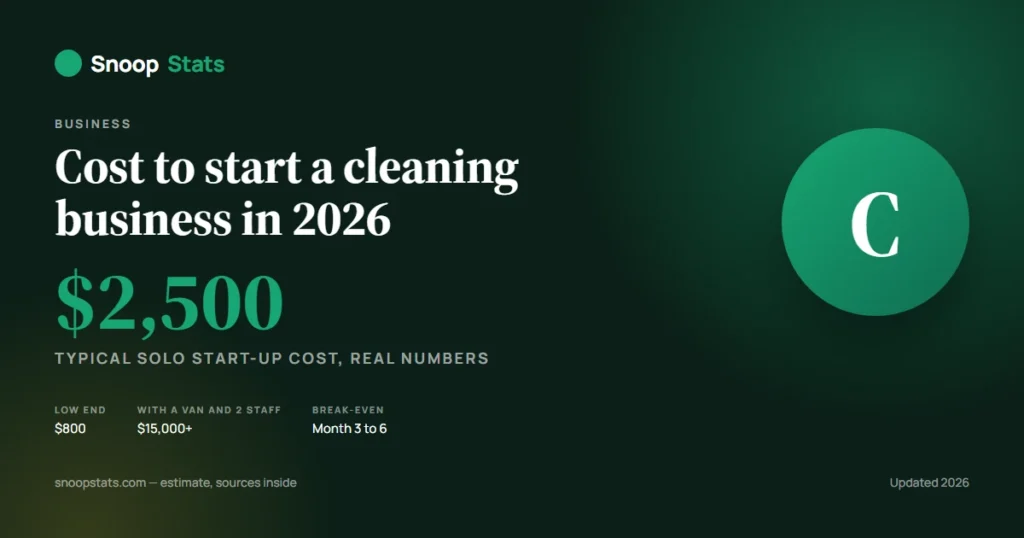
The cost to start a cleaning business ranges widely. A residential cleaning business is one of the cheapest legitimate businesses to start, which is why the numbers online range from “$200” to “$50,000”. Both are technically true. This breakdown shows three real setups, what each line item costs in 2026, and when each version breaks even.
Cost to start a cleaning business: The three ways to start
| Setup | Start-up cost | Monthly revenue potential | Break-even |
|---|---|---|---|
| Bare minimum, solo, your own car | $800 to $1,200 | $2,500 to $4,000 | Month 1 to 2 |
| Typical solo, insured and branded | $2,000 to $3,500 | $4,000 to $7,000 | Month 2 to 4 |
| Small team with a van | $12,000 to $20,000 | $12,000 to $25,000 | Month 4 to 8 |
Line-by-line: the typical solo setup ($2,500)
| Item | Cost | Notes |
|---|---|---|
| Business registration (LLC or sole trader) | $50 to $500 | Varies by state; sole trader is often near free |
| General liability insurance | $400 to $700 a year | Most clients and all property managers require it |
| Bonding | $100 to $250 a year | Optional but a selling point for house keys |
| Equipment: vacuum, mop system, caddy, microfibre | $350 to $600 | A good commercial vacuum is the main cost |
| Supplies for the first month | $100 to $150 | Concentrates are far cheaper than retail sprays |
| Uniform shirts, branded | $60 to $120 | |
| Website and booking software | $200 to $400 | Simple site plus a scheduling tool |
| Google Business Profile, flyers, first ads | $200 to $500 | Local Services Ads work well for cleaners |
| Car costs: magnets, extra fuel, mileage | $100 to $200 | |
| Total | $1,560 to $3,420 |
What the bare-minimum $800 version skips
No LLC (sole trader), no bonding, a household vacuum you already own, no website (Facebook page and Nextdoor instead), and $50 of flyers. It works for the first handful of clients found through friends. You add insurance the moment a client asks for it, which is usually within the first month.
What the $15,000 team version adds
- Used cargo van or wrap for an existing vehicle: $6,000 to $10,000
- Two additional equipment sets: $800
- Payroll setup, workers’ compensation, first month of wages before revenue: $3,000 to $5,000
- Larger insurance policy: $1,200 a year
- Marketing budget for the first quarter: $1,500
Ongoing monthly costs
For a solo cleaner: supplies $80 to $120, software $30 to $60, insurance $50, fuel $150 to $250, marketing $100 to $300. Total around $400 to $800 a month, which is why margins are high once you have 15 to 20 regular clients.
How much cleaners charge in 2026
Residential rates in most US metros run $40 to $65 an hour for a solo cleaner, or $120 to $220 per standard home visit. Deep cleans and move-out cleans are $250 to $500. Twenty recurring biweekly clients at $150 is $6,000 a month in revenue for roughly 80 hours of cleaning.
The mistakes that cost the most
- Underpricing to win the first clients, then being unable to raise rates.
- Skipping insurance and losing a property-management contract.
- Buying a van before you have the clients to fill it.
- Not using concentrates: retail sprays triple your supply cost.
- Taking one-off deep cleans instead of building recurring clients.
How to Get Your First Clients
Most cleaning businesses do not land their first paying client through a website or paid ads — they land it through people who already trust them. Posting in local community Facebook groups and neighborhood apps like Nextdoor, asking friends and family to spread the word, and leaving flyers at apartment complexes and small offices typically produce faster, cheaper results than digital marketing in the first few months, when there is no review history to build confidence.
Once there are a handful of completed jobs, a Google Business Profile becomes worth the setup time, since local searches for “cleaning service near me” rely heavily on star ratings and review count rather than website design. Asking every satisfied client directly for a review — rather than hoping they leave one unprompted — is the single highest-leverage marketing action a new cleaning business can take, because review volume and recency both factor into how Google ranks local service listings.
Licensing, Insurance and Legal Basics
Most cities and counties require a general business license before a cleaning business can legally operate, even as a solo operation working out of a personal vehicle. Requirements and fees vary by location, so checking with the local city clerk’s office or county business licensing division before taking on paying clients avoids fines later.
General liability insurance is the other non-negotiable, since a single accident — a knocked-over vase, a slip-and-fall on a wet floor — can cost far more than years of premiums. Many residential and commercial clients now ask to see proof of insurance before hiring, especially for recurring contracts. Bonding, which protects clients against theft by an employee, is a common add-on once a cleaning business starts hiring staff rather than operating solo, and some commercial contracts require it as a condition of the bid.
Should You Go Solo or Build a Team?
Working solo keeps startup costs at the low end of the range and means every dollar of revenue after supplies stays with the owner, but it also caps how much the business can grow, since one person can only clean so many homes in a week. Hiring even a single part-time cleaner roughly doubles capacity without doubling costs, since supplies and marketing spend are shared across more billable hours — but it also introduces payroll, scheduling, and the liability of someone else representing the business inside a client’s home.
Most successful cleaning businesses start solo to build a client base and cash reserve, then bring on help only once demand consistently exceeds what one person can handle — turning away work is usually the clearest signal that hiring has become worth the added complexity, rather than hiring speculatively ahead of demand.
Recurring Contracts vs One-Time Jobs
A one-time deep clean pays more per visit but requires constantly finding the next client, while a recurring weekly or biweekly contract pays less per visit but creates predictable, compounding revenue that makes cash flow far easier to plan around. Most established cleaning businesses aim to fill their base schedule with recurring residential or commercial contracts, then use one-time deep cleans and move-out cleans to fill gaps and generate leads for future recurring work.
Commercial contracts, such as small offices or retail spaces cleaned after hours, tend to offer the most stable recurring revenue of all, since business clients are less likely to cancel on short notice than an individual homeowner, and contracts are often set for a fixed term rather than a month-to-month arrangement.
Pricing Strategies That Maximize Profit
Flat-rate pricing based on square footage and number of rooms is easier for clients to understand and budget for than hourly billing, and it also rewards efficiency — a cleaner who finishes a flat-rate job faster keeps the time savings rather than losing income by working quickly. Hourly pricing can make sense for irregular jobs like post-construction cleanup or one-off deep cleans where the scope is hard to estimate in advance, but it caps earnings at the number of hours worked rather than rewarding skill and speed.
Add-on pricing for extras like inside-oven cleaning, refrigerator interiors, or window washing lets a business capture more revenue per visit from clients who want a deeper clean, without raising the base price for clients who only want the standard service. Reviewing prices at least once a year against rising supply costs and local competitor rates keeps margins from quietly eroding as expenses climb.
Software and Tools That Save Time
Scheduling and invoicing software built specifically for home service businesses can replace hours of manual text-message coordination and paper invoices, automatically sending appointment reminders that reduce no-shows and late cancellations. Many of these platforms also handle recurring billing automatically, which matters more as a client base shifts toward recurring contracts rather than one-time jobs.
A simple route-planning app that sequences same-day jobs by location can meaningfully cut driving time and fuel costs once a cleaning business has more than a handful of daily stops, turning what used to be guesswork into a repeatable, optimized schedule.
Seasonal Demand and Cash Flow Planning
Residential cleaning demand typically dips around major holidays and picks up sharply before them, as clients want their homes ready for guests, while post-holiday January is often one of the slowest months of the year. Move-out and move-in cleaning follows a different seasonal pattern, peaking in summer months when most residential leases turn over, which can help smooth out revenue for a business that offers both recurring residential contracts and one-time move-related cleans.
Building a cash reserve during the predictably busier months to cover the slower ones — the same emergency-fund logic applied to a business rather than a household — keeps a seasonal dip in bookings from becoming a cash-flow crisis, and it removes the pressure to accept underpriced jobs out of short-term desperation during a slow stretch.
When to Raise Your Rates
A fully booked schedule with a waiting list is the clearest signal that prices are below market and can be raised without losing clients, since demand is already exceeding what the business can supply at the current price. Rising supply costs — cleaning products, fuel, insurance premiums — are a second, more defensive reason to raise rates, ideally reviewed on a fixed annual schedule rather than only when margins have already become uncomfortably thin.
Existing recurring clients are typically more price-sensitive to a sudden large increase than new clients quoted the higher rate from the start, which is why many cleaning businesses phase in rate increases with 30 to 60 days’ notice for current contracts rather than applying the new number immediately.
Equipment That Pays for Itself
A commercial-grade backpack vacuum, while a bigger upfront cost than a standard upright, typically cuts cleaning time per room enough to pay for itself within the first few months for anyone cleaning multiple properties a week. Microfiber cloths and mop heads, though pricier per unit than disposable alternatives, last through hundreds of washes and reduce the ongoing per-job supply cost that a lower-quality alternative would otherwise keep adding up.
The general pattern holds across most equipment decisions in this business: spending more upfront on durable, professional-grade tools tends to lower the true cost per job once time savings and replacement frequency are factored in, even though the receipt at purchase looks larger than the budget option.
Getting Started With Confidence
None of the startup costs, licensing steps, or pricing decisions above need to be solved perfectly before taking a first paying job — most successful cleaning businesses refine pricing, add insurance, and decide on hiring only after real client demand makes those decisions clearer than they would be on paper. Starting small, tracking actual costs against the estimates in this guide, and adjusting from there is a more reliable path than waiting until every detail feels fully planned out.
Whichever path a new cleaning business takes, the businesses that last past the first year are almost always the ones that treat pricing, licensing, and client communication as seriously as the cleaning work itself, not as paperwork to handle “eventually” once things slow down.
People Also Ask
How much money do I need to start a cleaning business?
About $2,500 for a properly insured solo business, or as little as $800 if you start with your own equipment and no formal registration.
Is a cleaning business profitable?
Yes. Solo cleaners commonly net $3,000 to $5,000 a month with 15 to 20 recurring clients; margins are 50 to 70 percent because overheads are small.
Do I need a licence to start a cleaning business?
Most places need only a basic business registration. Some cities require a business licence; check your local authority. Insurance is not legally required but clients expect it.
How long until a cleaning business breaks even?
Two to four months for a solo setup, four to eight months for a team with a van.
The Small Business Administration has a free guide to registering and licensing a service business, and once you have started, tracking expenses against our 50/30/20 budget keeps your personal finances separate from the business.